
When I first started writing picture books, I figured there’d be a bit of a learning curve. But I was already a writer. I had produced television credits! If I’m honest, part of me thought it would come naturally. That… wasn’t actually true. Sure, I could string words together, but I didn’t know the conventions of the form. I hadn’t studied the craft. Eventually, it became clear that was holding me back. If I wanted to progress, I decided I had to sign up for classes. Ultimately, I joined Storyteller Academy. Since that time, I’ve taken many classes, joined organizations, multiple critique groups, attended webinars (free and paid), went to conferences, and the list goes on and on. But the one thing I haven’t done… enroll in a university and earn a degree. In 2017, when I started writing for children, I was working full time and I never thought it was an option for me. But even though I didn’t consider that path, I’d always been curious about it. (I took a course called Writing Children’s Literature in college and loved it.) So this month, we’re talking to Donald Sutton, a writer-illustrator who got an M.F.A.! Maybe the conversation will help you decide if an M.F.A. is right for you. Or maybe you’ll just live vicariously through his experiences being immersed in children’s literature. Either way, this interview is in session!
Let’s meet Donald!
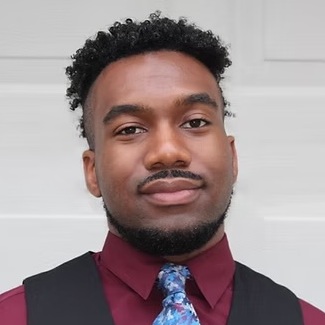
DONALD SUTTON (he/him) is a writer and illustrator for both picture books and graphic novels. He graduated from Hollins University’s Children’s Book Writing and Illustration Master of Fine Arts Program in 2025. He’s a member of SCBWI and was a 2020 We Need Diverse Books Illustration mentee. He loves writing and illustrating stories that are humorous, fantastical, and full of heart for all children, including those from underrepresented backgrounds and communities.
When he’s not writing and illustrating, he enjoys spending time with family, photography, and training martial arts.
Q: HELLO, DONALD! LET’S GO BACK TO THE BEGINNING. WHEN DID YOU START CREATING BOOKS FOR CHILDREN?
I started back in early 2019. Truthfully, I knew I always wanted to become a children’s book illustrator or animator. I initially pursued animation, and I was close to finishing a Bachelor of Fine Arts at the Savannah College of Art and Design. But near the end of my senior year, I went through a tough personal event and considered giving up altogether. Instead, what changed my mind and my perspective was my faith. I felt called to pursue children’s books instead of pursuing a career in animation.
Q: WHY DID YOU START WRITING/ILLUSTRATING PICTURE BOOKS?
To bring more representation to children’s literature. Growing up, I didn’t see much diversity in books and other forms of media, especially representation of people who look like me. When I did, the stories usually centered around topics of “Black pain,” escaping slavery, or struggle narratives. Stories like these are important and come with worthwhile payoffs such as freedom, justice, attaining necessary rights, and civil liberties.
In fiction, we were either almost always delegated as the sidekick, subjected to tokenism, or we weren’t shown at all in the fantastical worlds that appeared on screen. I felt we could use more stories that feature positive representation especially in fiction. I wanted to create more diverse stories so everyone can feel seen, including kids who look like me. I saw a quote from actress and producer Marsai Martin where she said: “Don’t give me this — I don’t do Black pain. If it’s Black pain I don’t go for it because there’s so many films and projects about that, so that’s not who I am. I want to make sure that it is diverse and real in its own way.” That quote resonated with me and I began learning about the Black Joy Movement. Her quote served as a sign for me to start writing stories that focused on Black joy.
Q: HOW DO YOU GET THAT JOY ON THE PAGE? WHAT FORM DO YOUR STORIES TAKE?
I focus on stories that feel diverse and relevant. They’re about everyday situations that a lot of kids, especially in communities of color, can relate to and give them happiness when they read it. In retrospect, if they’re fantastical, I write stories where diversity isn’t commonly seen, and display it front and center. The joy comes from writing stories that I wish I could have read when I was a kid. My stories are centered around diversity, humor, joy, fantasy and free verse/poetry. I focus on these topics in both picture books and graphic novels.
Q: WHAT IS YOUR CURRENT FAVORITE PICTURE BOOK? WHY?
I’d say THE KING OF KINDERGARTEN by Derrick Barnes and Vanessa Brantley-Newton is my favorite. I love the encouraging and playful language accompanied by the beautiful illustrations! It is always a joy to pick up and read!
VANESSA BRANTLEY-NEWTON IS AMAZING. I’VE TAKEN CLASSES WITH HER AT STORYTELLER ACADEMY!
Q: SPEAKING OF CLASSES… WHY DID YOU DECIDE GETTING AN M.F.A. WAS RIGHT FOR YOU?
I began learning how to write and illustrate children’s books online and through studying published books. However, I learn best with structure and accountability, so I knew going to school would be the best experience for me.
I’M THE SAME WAY. IF THERE’S A DEADLINE FOR TURNING IN AN ASSIGNMENT, I’M WAY MORE MOTIVATED TO DO IT!
Q: HOW DID YOU FIRST HEAR ABOUT HOLLINS UNIVERSITY?
I knew I’d thrive better in a school setting, so I began researching master’s programs for children’s books. Research results showed Hollins University to be one of the top schools in this area. They had a great program, great professors, and the alumni were doing amazing things in the children’s book field.
Q: DID YOU CONSIDER OTHER SCHOOLS BEFORE ULTIMATELY CHOOSING HOLLINS?
No, I didn’t really! When I researched Hollins University, its Children’s Book M.F.A. Program, and spoke with some of the faculty through email, it aligned with all of my interests. I knew this is where I needed to go.
THAT MAKES SENSE, ESPECIALLY AFTER I READ THAT HOLLINS IS THE ONLY PROGRAM IN THE U.S. TO OFFER AN MFA IN WRITING AND ILLUTRATING.
Q: WHAT WAS THE BEST PART OF THE PROGRAM? WHAT DID YOU FEEL WAS THE MOST VALUABLE?
It’s hard for me to pick the “best part” because there were so many factors that made my time in the Children’s Book M.F.A. Program such a positive experience: the classes, the professors, the beautiful campus, the resources and mentorship availability, and my fellow classmates whom I studied and grew alongside.
Initially, I’d enrolled in the Hollins University Certificate in Children’s Book Illustration. I didn’t know how to properly write picture books at the time. I only wrote stories to show off my skills as an illustrator. After my first summer at Hollins, I had a meeting with one of the professors of the program, author Lisa Fraustino, to ask for advice. She mentioned I should seriously consider writing in addition to illustration. She told me she liked my illustrations but noticed I spent time writing and always mentioned how I kept saying, “One day I’d like to create my own stories.” She challenged… Instead of waiting for “one day” why not start now? She encouraged me to take the time to build confidence in my stories and find a voice of my own.
After encouragement from her, friends, and family, I began taking my writing seriously and enrolled in Hollins University’s Children’s Book Writing and Illustration M.F.A. Program.
THAT’S AWESOME. MENTORS WHO TRULY SEE YOU AND WHAT YOU’RE CAPABLE OF ARE INVALUABLE.
Q: WHO WERE A FEW OF YOUR OTHER TEACHERS AND MENTORS? I ALSO READ THERE ARE ILLUSTRATORS- AND WRITERS-IN-RESIDENCE!
I had the pleasure of meeting and working with many wonderful writers and illustrators throughout my time at Hollins. There were many teachers and visiting teachers that influenced my journey and learning experience. They included Ruth Sanderson, Ashley Wolff, Mary Jane Begin, Lisa Fraustino, John Gurney, Dr. Anne Phillips, Candice Ranson, Dr. Karen Chandler, R. Gregory Christie, and Dr. Michelle Martin to name some of them. Mentors included the current director of the Children’s Literature Program, Dr. Elizabeth O Dulemba, and visiting teacher Dhonielle Clayton, who always took the time to meet with me and give me advice.
And yes, every summer, Hollins had an illustrator, writer, and scholar in-residence who would come talk to students, host a course or special topic, and give lectures to share their experiences. For example, my first year at Hollins we had E.B. Lewis as an illustrator-in-residence. He held a lecture for our programs, a special demo workshop for the illustrators, visited our classes, and in following years became a visiting teacher.
Q: WHAT KINDS OF CLASSES DID YOU TAKE?
I took a variety of classes ranging from writing and illustration, to scholarly/critical focused children’s book courses. Each one proved to be enlightening and helpful on my journey to finishing the program. As a writer and illustrator who focuses on picture books and graphic novels, I made sure to choose courses that reflected my interests. I’d say that all of my courses were valuable as they dealt with writing picture books, illustrating picture books, creating graphic novels, poetry for picture books, and the foundation courses were critical as they were the bones that led me into the specialty areas.
Q: I’VE TAKEN CLASSES THAT SOUND SIMILAR TO WHAT YOU’RE DESCRIBING. HOWEVER, THE ONE THING I HAVEN’T REALLY COME ACROSS ARE THE SCHOLARLY CLASSES YOU MENTIONED. CAN YOU TALK ABOUT THOSE COURSES AND WHAT THEY ENTAIL?
Scholarly courses focus on specialized topics surrounding children’s books. They examine the historical aspects, modern trends, and more, forcing you to look at them from critical standpoints. One class I took was called History and Criticism of Children’s Literature. This course examined early influential children’s book stories, how they’ve evolved over time, and examining what could be considered influential children’s books of the modern ages.
Critical Studies in Form/Genre: African American Children’s Literature was another critical class that I took. This course covers a similar topic to History and Criticism, but examines the portrayal of Black people in children’s books throughout history. This class was very intuitive as it shed light on avoiding stereotypes, examined powerful African American authors and illustrators throughout history and how they created positive representations, and asked thought-provoking questions when it came to writing diversely.
AS I SUSPECTED, I HAVEN’T TAKEN A CLASS LIKE THOSE BEFORE. IT SOUNDS AWESOME TO ANALYZE THE BIGGER PICTURE IN CHILDREN’S LITERATURE AND REALLY STUDY IT OVER THE YEARS.
Q: WHAT WAS THE GOAL OF YOUR PROGRAM? DID YOU HAVE TO COMPLETE A PORTFOLIO OR A CERTAIN NUMBER OF STORIES?
For the Children’s Book Writing and Illustration M.F.A., the goal was to complete your degree hours and write a thesis on a topic of your choice with accompanying creative work(s). I wrote a thesis, a middle-grade graphic novel, and illustrated a pitch for it. (Some of my classmates opted to write their thesis and write and illustrate three picture books to accompany their projects. It depends on what you’d like to focus on and write about.)
The name of my thesis was “Black Joy: Positive and Diverse Representation in Fiction.” I chose this topic similar to my “why” when it came to creating children’s books: to create more positive representation of children from diverse communities. Although I felt the children’s book publishing industry has recognized that more diversity is needed, the number of books written about joy in communities of color are still few compared to those written about struggle and pain. I wrote about how I believe there needs to be more stories about fictional Black joy, and how I propose that doing so will inspire and engage more diverse readers, including children of color. As a part of my thesis, I wrote my own fantasy middle grade graphic novel pitch filled with Black joy and illustrated it. Once completed and approved by my supervising committee of professors, the thesis and pitch were uploaded to the Hollins graduate portal. My peers and other professors were able to read it from there.
Q: LET’S TALK LOGISTICS. HOW LONG WAS THE PROGRAM? WERE YOU IN SCHOOL FULL TIME? WERE THE CLASSES IN PERSON OR ONLINE?
I was a full-time student at Hollins. At the time I attended, the graduate program was in-person during the summers, and classes during the spring and winter semesters were part-time, online. I started in Summer 2019 and graduated in Fall 2025. (I switched from the Certificate in Children’s Book Illustration to the full M.F.A., and this did take more time to finish.)
Since I’ve graduated, the program can now be completed in just over two years or spread out according to the needs of the student.
Q: IS IT EXPENSIVE TO GET AN M.F.A.?
Graduate school in general can be costly, but Hollins and its Children’s Book Writing and Illustration M.F.A. provided us with plenty of opportunities for financial help such as scholarships, financial aid, and work-study programs to make our education affordable.
Q: HOW DO YOU FEEL YOUR DEGREE HAS HELPED YOU? WHAT LESSONS OR TOOLS ARE YOU TAKING WITH YOU AS YOU PURSUE PUBLICATION?
My degree has helped me become more knowledgeable and confident in my craft. I’ve learned so much and have progressed as both a writer and an illustrator.
One of the most valuable lessons I’ve learned since graduating is to take the chance and try for opportunities you may think are beyond your reach. I’ve always been very critical of my own works. I would barely show anything or apply to opportunities that would seem perfect for me. This mentality was crippling, and I probably missed out on plenty of opportunities. Going through this program and attaining my M.F.A. has taught me I’m capable of much more than I’ve realized, and that you’ll never truly know until you try for something.
YOU’RE NOT ALONE IN THAT. I THINK AS CREATORS, WE CAN DEFINITELY BE HARD ON OURSELVES. WHICH IS WHY I ADDED THIS QUESTION TO THE INTERVIEW…
Q: CELEBRATE YOURSELF! WHICH WRITING ACCOMPLISHMENT MAKES YOU FEEL THE PROUDEST?
I’d have to say my proudest writing accomplishment is completing my 103-page thesis and attaining my M.F.A.! There were so many times I doubted myself in that journey, but I persisted and was blessed to succeed.
Q: HOW DO YOU HANDLE REJECTION?
Although rejections sting, I see them as an opportunities that weren’t meant for me. For some reason or another, it wasn’t meant to be and that is perhaps for the best. I take what feedback I can from the rejection, see what I learn from it, see how I can apply it to make myself better, and prepare myself for the next endeavor. I also take time for self-care, invest in my hobbies, draw, paint, spend time with family, do things that I enjoy, and be kind to myself.
A FRIEND OF MINE LIKES TO SAY: “REJECTION IS PROTECTION.” I THINK THAT’S A SIMILAR SENTIMENT!
Q: WHAT KEEPS YOU WRITING?
My dream to create stories full of humor and heart where everyone feels seen, especially kids from underrepresented communities like my own. Also, whenever I feel like giving up, I remember the words of my late mentor, Floyd Cooper, from my time as a 2020 We Need Diverse Books Illustration mentee: “The world needs your voice too.”
Q: I LOVE THAT. WHAT HAS WAITING FOR YOUR “YES” TAUGHT YOU?
Publishing takes time. It may not happen right away, but if I am persistent and don’t give up, something can and will change. It may have been a “no” today, but if I keep going, it’ll turn to a “yes.” All I need is for one person to say yes.
Okay, I’m feeling slightly jealous after hearing about your experiences, Donald! Thank you for sharing them!
In doing research for this interview, I came across this quote from Program Director, Dr. Elizabeth O Dulemba: “The magic comes not only from immersing yourself in a topic you are passionate about, but also from doing so with people who share your passions. How often in life are you surrounded by people who regularly make references to the same things you enjoy?” While I have certainly enjoyed many of the classes I’ve taken online and love their accessibility, I’ve often missed that in person connection. I’m not sure I’ll be able to do a program like this… but I’m not saying never!
If you’d like to keep in touch with Donald, you can find him on Instagram and TikTok as @dons_kreation. He’s also on Bluesky as @donskreation.bsky.social. And he has a website: www.donaldadsutton.com.
This month, I’m giving away a PICTURE BOOK QUERY CRITIQUE! (I’m gearing up to submit a few queries so my current obsession with writing pitches is your gain!) In order to enter, subscribe to my newsletter. Everyone who’s subscribed by 11:59PM PT on December 9th, 2026 is eligible to win. (No purchase necessary. You must be 18+ to enter.)
Leave a Reply